

Overview:
The NBA has evolved from the very vague definition of players that is given in a starting lineup. Centers can now shoot threes, power forwards are taking the ball up the court, and point guards are now 6'9. The old idea of five positions that each player is described as does not accurately describe how the modern era of the NBA is played. Thus, I aimed to find these new 'positions' that NBA players are now a part of.
Dataset/Exploration
The first step in finding these new positions is choosing the quantitative metrics that define what a position is. Similarly to how the current positions group players regardless of how 'impactful' they are (ie Wembanyama and Quentin Post are both considered centers), our new positions should not include total metrics, or metrics that try to quantify how effective the player is in an overall sense (ie plus/minus, PTS, or BPM). The best way to try and articulate a player's archetype would be percentage statistics that gauge what the player is most likely to do, such as assist ratio, offensive rebound ratio, and usage rate. I would also like to include where they are more likely to shoot from, so shot attempt percentages such as three-point attempt rate and free throw attempt rate will be used. Finally, I would like to include regular shot percentages to try and distinguish players who might be known for their shooting from players who are not.
The final statistics that will be used are: 3-Point Percentage, 2-Point Percentage, Free Throw Percentage, 3-Point Attempt Rate, Free Throw Attempt Rate, Offensive Rebound Percent, Defensive Rebound Percent, Assist Percent, Steal Percentage, Block Percentage, Turnover Percentage, and Usage Rate.
We can then take the average OBPM and DBPM of each group to then gauge these groups offensive and defensive impact.
Data Analysis
The best way to separate all players into these new archetypes is by using a K-Means clustering algorithm. This allows us to split players based off all the metrics we listed earlier to find these new groups. There are only three things we need to cover before using sklearn's KMeans clustering algorithm.
Preprocessing
I will be using Basketball Reference's player averages from the 2025-2026 NBA season for this. Using both the 'Advanced' table [1] and the 'Per 100 Poss' table [2] allow us to get both the action percentages we need as well as the shooting splits. Basketball Reference's player average pages can have multiple rows for players that played on multiple teams in the same season, such as James Harden playing on both the 76ers and the Cavaliers. Luckily, Basketball Reference contains both these teams separately, as well as player averages over their entire season, so the only concern is removing the rows that do not correlate to that player's entire season.
Another issue that needs to be addressed is when a player never shoots from a specific distance. For example, players like Mitchell Robinson and Jakob Poeltl never shot a 3 the entire season, and basketball reference leaves it as NULL value, which KMeans does not like. All this requires is making sure that null values in the shooting percentages are filled with 0%.
Finally, although not necessary, there should be a limit on the amount of players used in the clustering algorithm. While not a scientific reasoning, I chose 820 total minutes played in the NBA season as the cutoff. This allows both role players that had enough minutes to find their role such as Sam Hauser, as well as players who got injured but still played enough minutes to be impactful such as Steph Curry. Both tables include a minutes played column, which makes the preprocessing easier.
Standardization
We need to make sure our parameters are standardized, as percentages such as steal rate tend to vary less than rebound rate. We can easily use sklearn's standardization function to do this in one line of code
hyperparameters
Finally, an important quality of Sklearn's KMeans is that the user specifies how many groups there are in the clustering algorithm. For our goal, we do not need a specific number of groups, rather we want the number of groups that seems to best split players into player archetypes without creating too vague of divides. This is where KMeans scores, such as inertia, help to find a best stopping point for the number of groups. Testing the inertia score on 2 groups up to 12 gives us these scores:
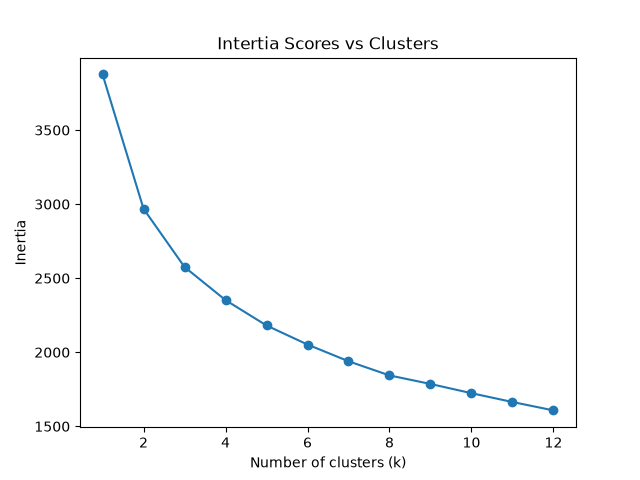
Unfortunately, the elbow method does not give an obvious cluster mark to choose, but the inertia scores start to decrease linearly around the 8-cluster mark, so we will use that as our number of clusters for our KMeans. I also checked the results when using 7 or 9 clusters and found similar groups to that of 8 clusters.
Results
After running KMeans with 8 different clusters, we can now analyze each result to see how each player is actually used in the current NBA.
1. The rim-running bigs
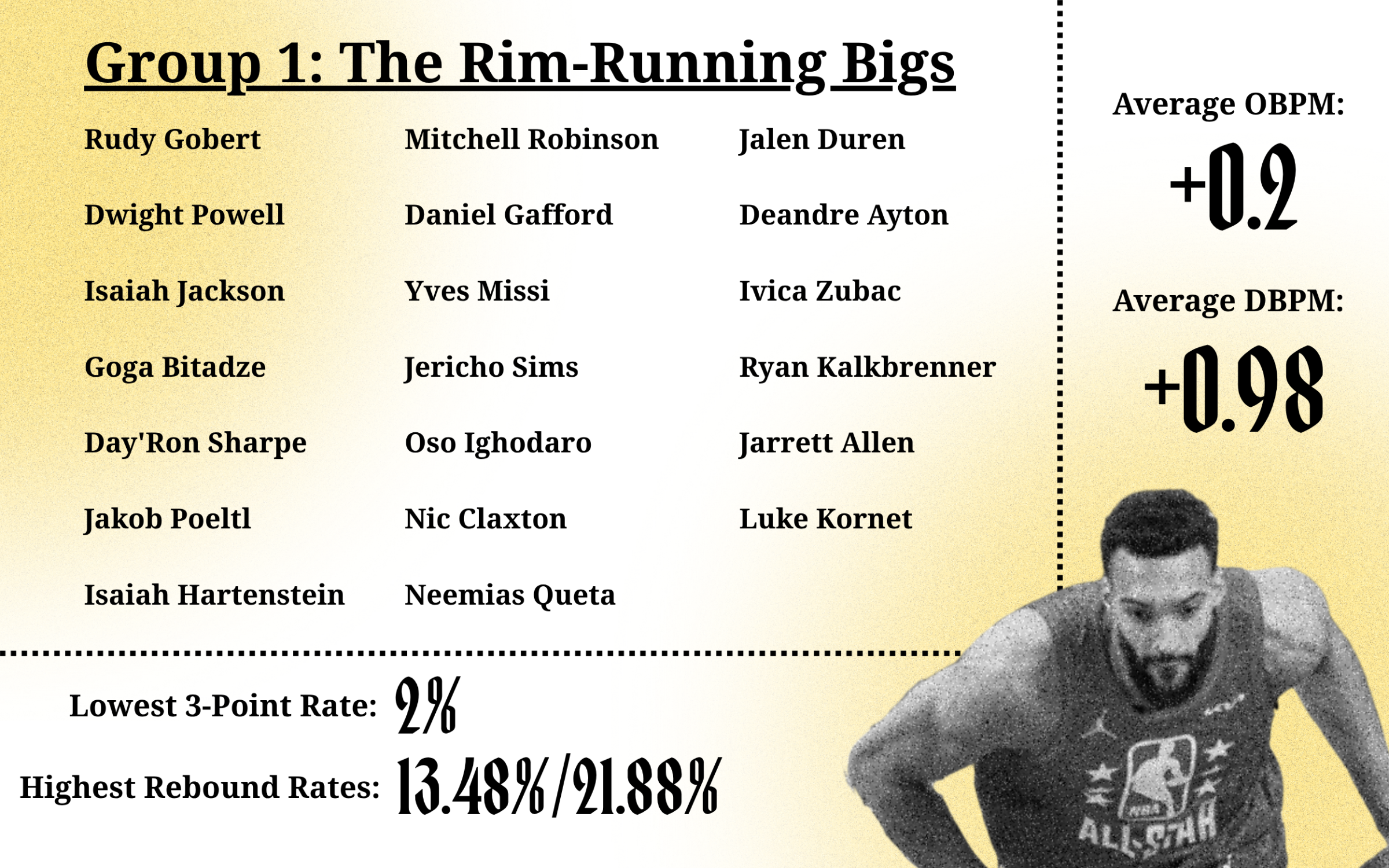
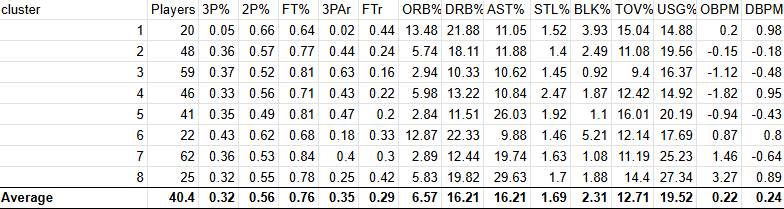
The first group is, funnily enough, what an older NBA fan might consider the classic 'Center' role. These players are most likely those that were always tall and came into the NBA with their length as their strongest feature and are utilized for it. With the highest and second highest rebounding rates out of all groups (13.48% ORB% and 21.88% DRB% respectively), these players stick in the paint without playing on the ball (lowest usage rate of 14.88%) or taking threes (2% with a 5% 3PT%).
Interestingly, this group is one of only three groups to have both a positive OBPM and DBPM, which implies that even though this type of player is a dying breed (only 20 players total, smallest out of all groups), those that rebound well, create a defensive presence (3.93% Block Rate), and can get to the line (44% FtR) can still be extremely useful in this modern era of three point shooting.
2. The versatile bigs
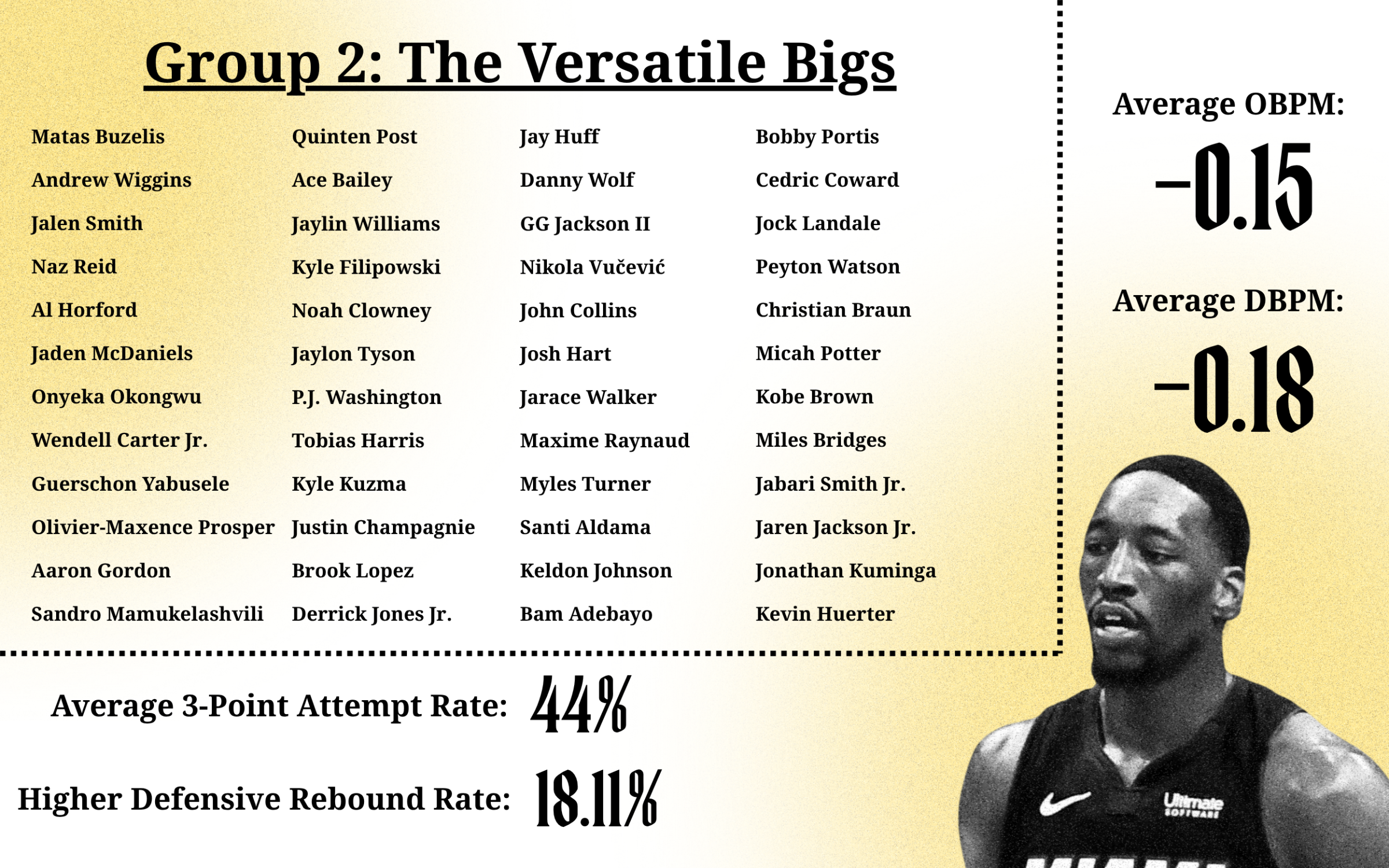
This next group are forwards that try and be more creative on offense but sacrifice their efficiency on the defensive side compared of the first group to do it. These bigs are known for using their height to get rebounds on defense (18.11% DRB%) and to try and stretch the floor when needed (44% 3PaR, 36% 3P%).
This is what the modern NBA has forced many taller players to try and become to fit into the three-point revolution. These are the stretch bigs that every team needs to space the floor and have a larger role in the offense compared to our first group of players (19.56% usage rate). While some larger star players like Bam Adebayo and JJJ are in this group, most players are your average NBA forward who does not have the offensive rebounding tools to be a part of group 1, or the playmaking skills to be considered an NBA star. This explains why this group has close to a league average BPM (-0.33).
3. 3&D Role players
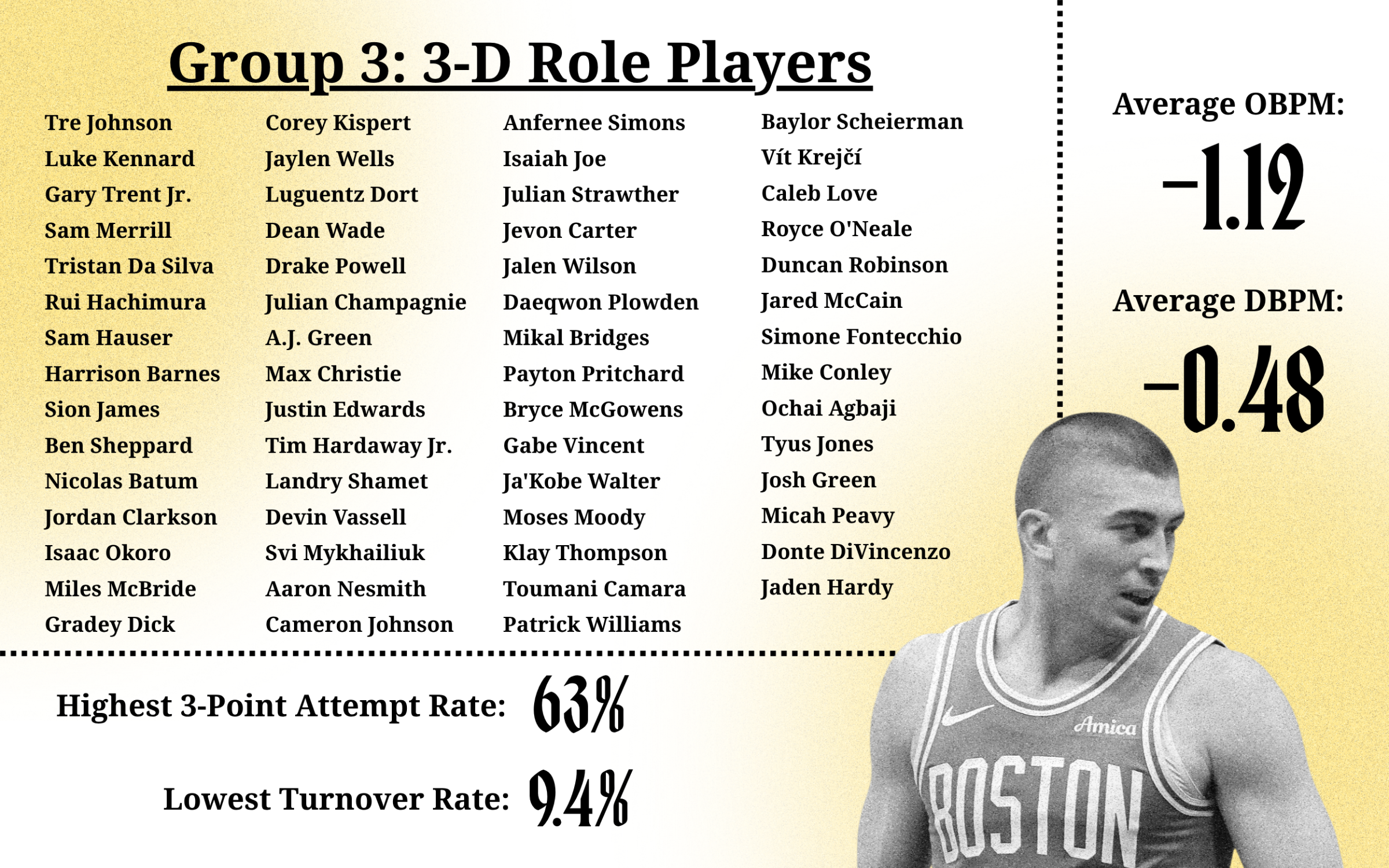
The second largest group (59), and the essential role that is most connected to the modern NBA is the 3&D player. Role players are almost always required to have a 3-point shot these days to be signed to a team, and if you are not a score-first guard, you also need to have an impact defensively to stay on the roster. These players often sit in the corner on offense (16.37% usage rate, second lowest AST%, lowest TOV%) and try to be a defensive pest.
Although a necessary part of the current NBA, these players are similar to the stretch bigs in group 2, where they do not have the skills to be a more efficient scoring engine and are reduced to the position where they can be best utilized. Not a single consensus top 25 player is in this group, which explains why both the OBPM and DBPM are once again negative. Players like Julian Champagnie and Payton Pritchard have shown nights where they can explode for 30 points, but are unlikely to ever become a leading scoring option on a team anytime in the future.
4.Defensive specialists
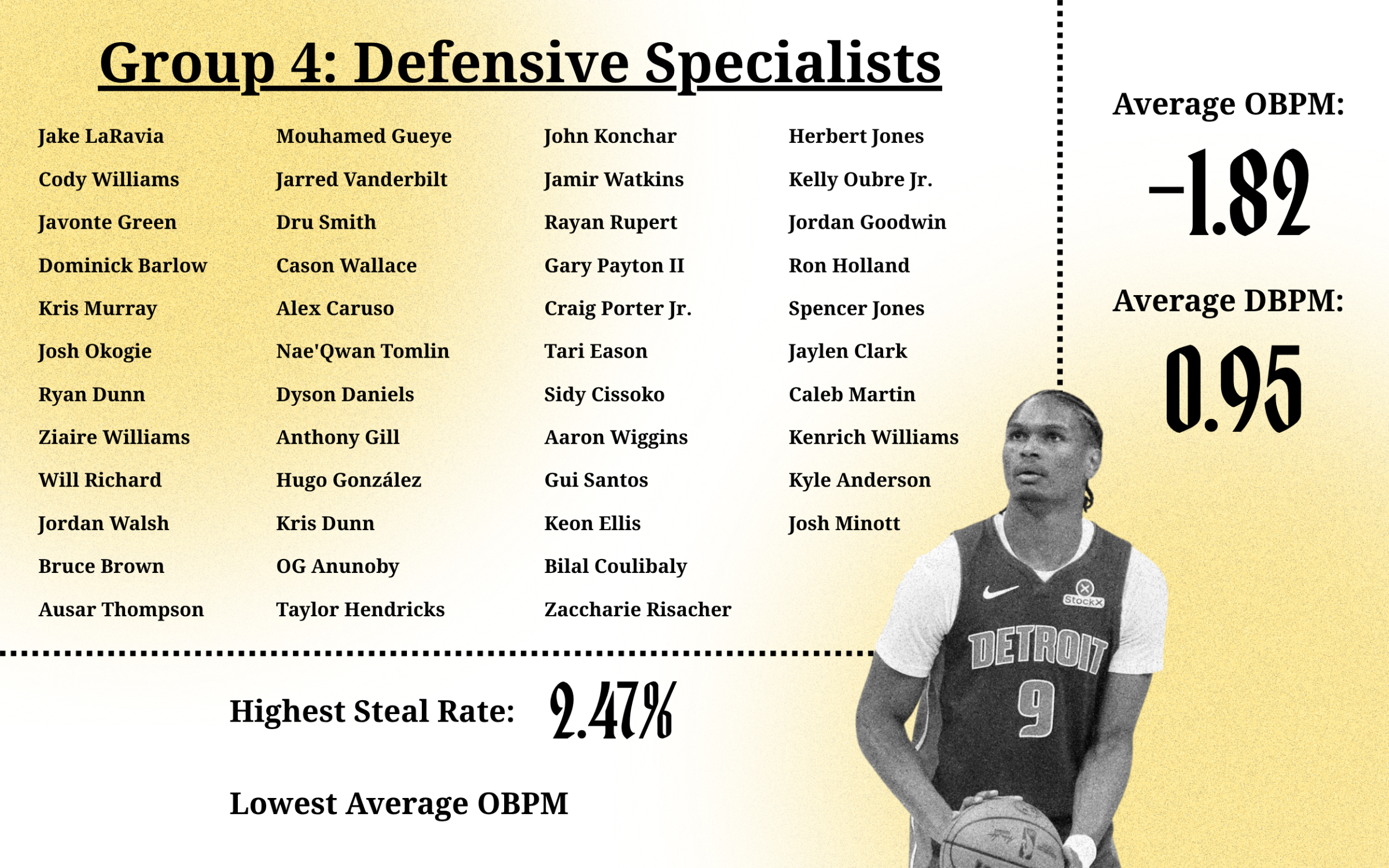
Much like how group 1 and group 2 split up role playing forwards/centers into an offensive and defensive pairing, group 4 would be considered guards/wings that are more defensive, perimeter defensive specialists that don't shoot very often. Players like Alex Caruso on the Thunder and Ausar Thompson on the Pistons highlight how this group is known for being ferocious on the perimeter (2.47% steal rate). These players have the second lowest usage rate (14.92%) but unlike the previous group, show enough effort on defense and rebounding (5.98% and 13.22% rebounding splits compared to group 3's 2.94% and 10.33% splits respectively) to create a role for themselves on the floor.
Don't be surprised to see one of these players in contention for DPOY this season, as while the main defensive anchors such as Victor Wembanyama and Rudy Gobert are top contenders for the award, the media always loves to shout out the smaller guards/forwards that show their worth through their steals such as Dyson Daniels in 2025 and Marcus Smart in 2022.
5. pass first point guards
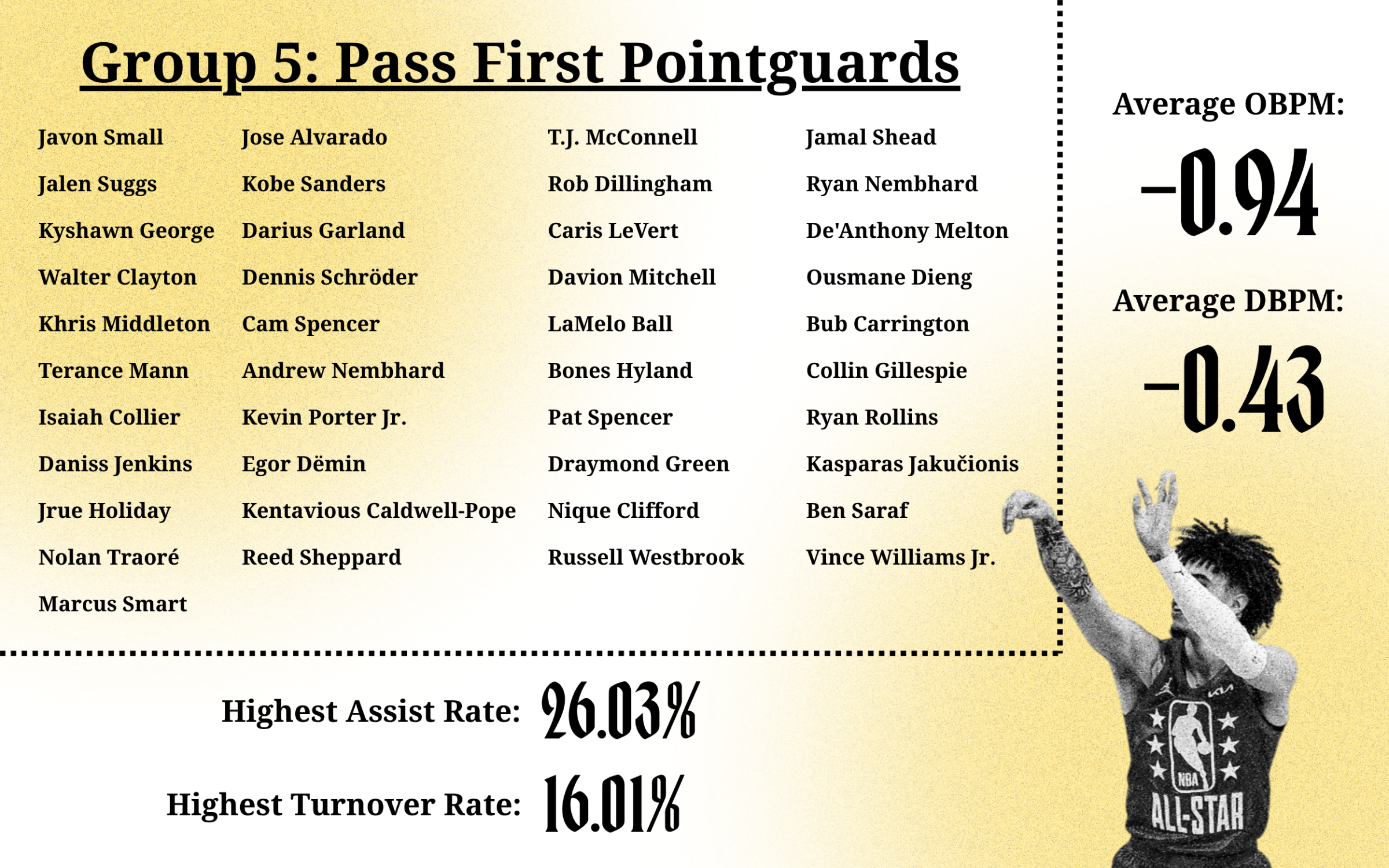
Our next group can be considered the traditional point guard/playmaker role. With the highest assist rate (26.03%) and the highest turnover rate (16.01%), they live and die by their passes. Although some players in this group have other abilities, such as Jrue Holiday and Marcus Smart's defense, their lack of consistent shooting (lowest 2P% of 49%) and inside scoring (20% FtR) keep them from being efficient offensive weapons and ending possessions with the ball in their hand (average usage rate of 20.19%).
While most of these players are who you would imagine would fit the pass first point guard role, two players seem to be sticking out, that being Lamelo Ball and Darius Garland. Both of these players tend to be more of a primary scoring than the archetype they land in, and we can see that with their higher usage rates (32% and 27.4% for Lamelo and Garland respectively). What seems to land them in this archetype is both of their extremely large assist percentages (42.6% and 34.9%). Most likely this is because of the amount of scoring options these players had last year, with Lamelo having Kon Knueppel, Miles Bridges, and Brandon Miller, and Darius Garland having a wealth of scoring options on both the Cavs and Clippers.
6. modern rim-protecting bigs
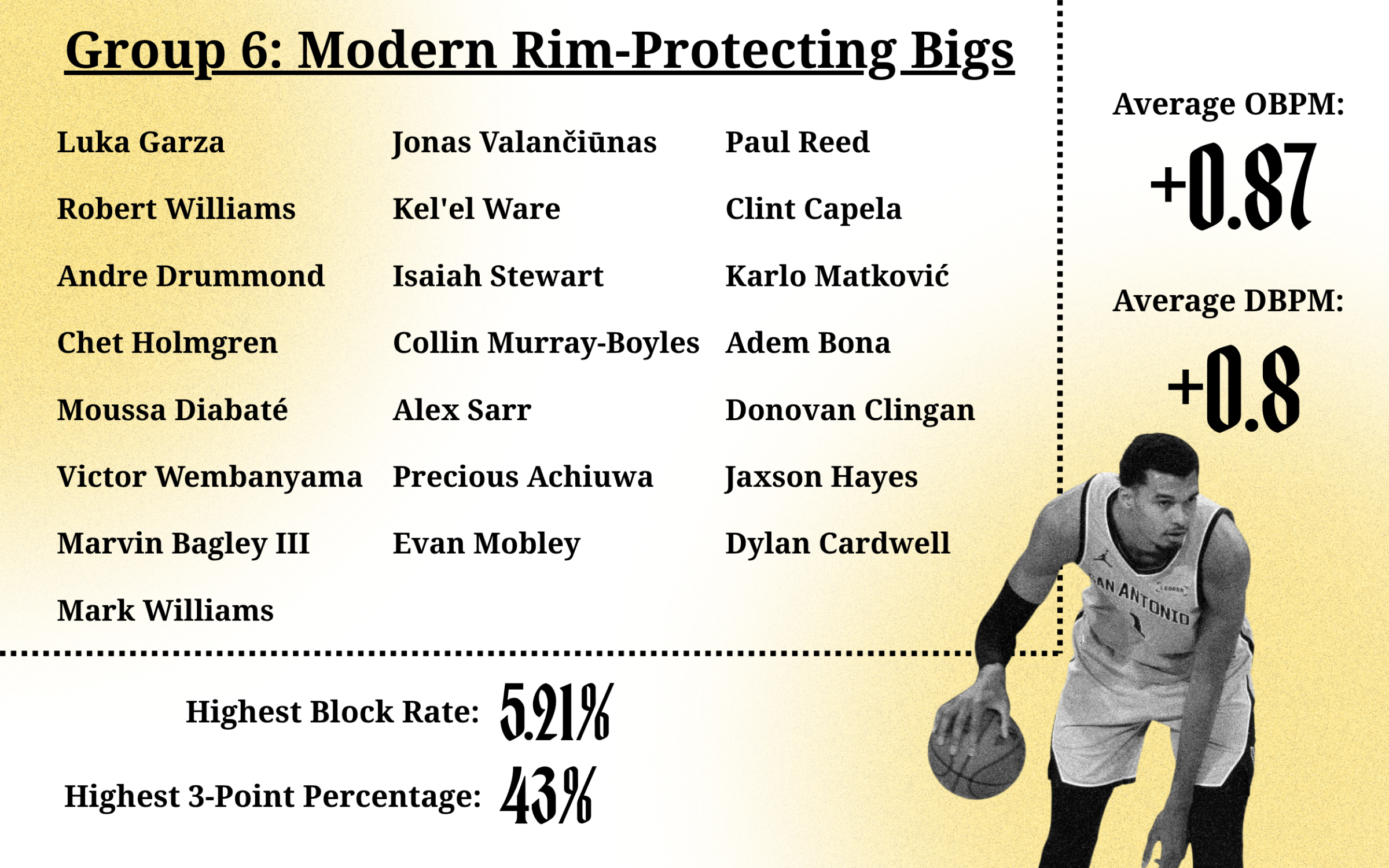
The last groups of bigs that comes from this experiment are the modern rim-protecting bigs. They combine the best of both the rim-running bigs rebounding skills (12.87% ORB% and 22.33% DRB%), and are 43% from three on a low 18% attempt rate. This being while they also have the highest block rate of any group by a large margin (5.21%). A lot of players in this list are excellent centers who have already established themselves such as Wembanyama and Holmgren, as a well promising young players like Kel'el Ware and Collin Murray-Boyles who make threes at a higher rate than the typical center (39.5% and 34%).
A lot of players in this group are high value players that can make or break a team's balance if they are playing well or not. Players like Evan Mobley and Mark Williams don't have the highest praise from fans, but their teams would not be able to stretch the floor without their shooting and would struggle to defend the paint without their blocking. This is why this group has the second highest total BPM out of all groups.
7. score first guards
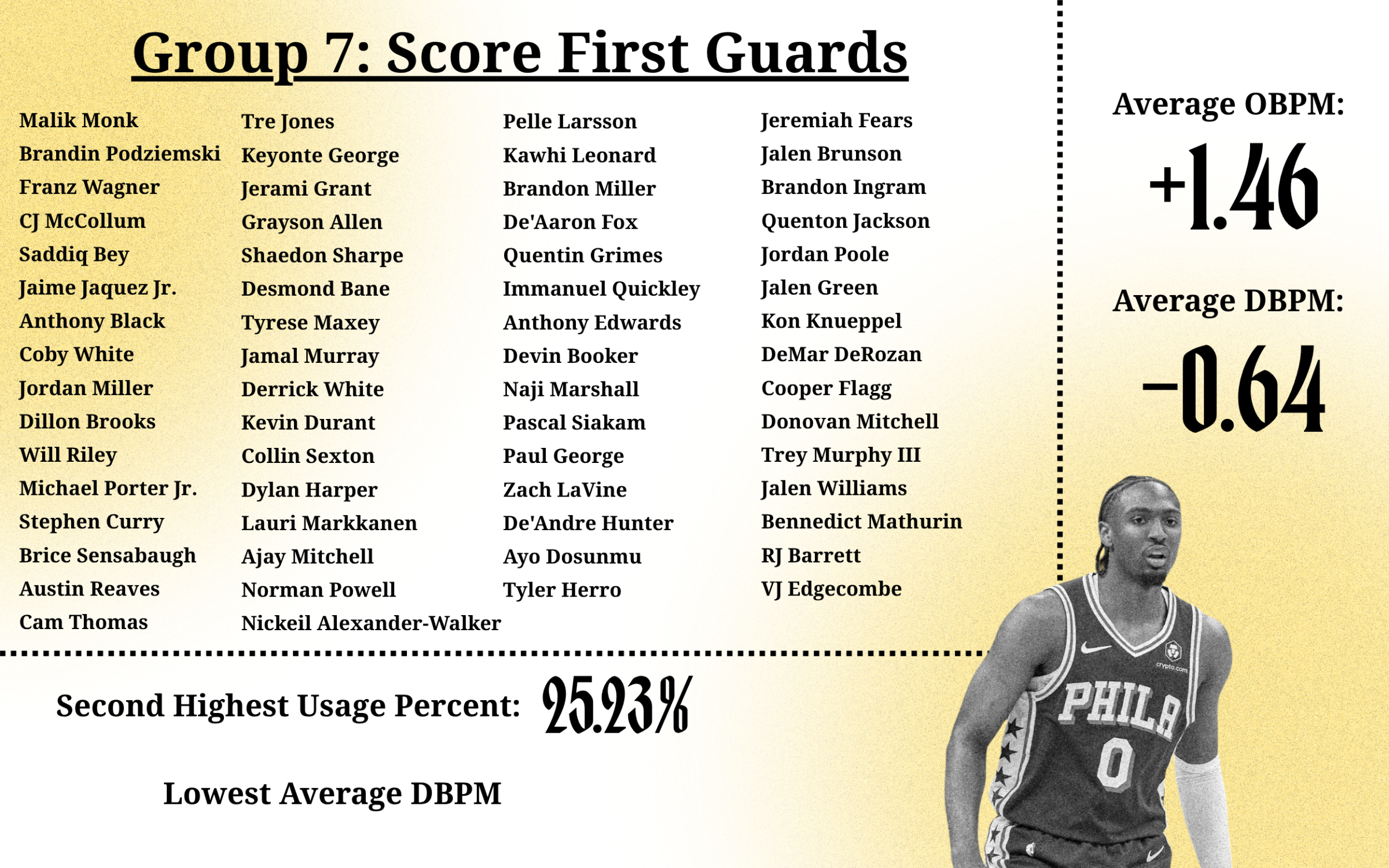
Unlike the previous group's guards, this group focuses on scoring as their main reason to be on the court. With the lowest average DBPM, they are most likely the biggest defensively liability on your team but make up for it with their prolific shooting (84% FT%, league average 2PT% and 3PT%) and high playmaking ability (19.74% AST%). Both superstars like Steph Curry and Kevin Durant, as well as plug in scorers like Ayo Dosunmu and Grayson Allen fill out this group by being able to score and facilitate in any part of the game.
This is the largest of all groups and is most likely because these players are dominant offensive players that might not do many of the other parts of the game, such as rebound or defend at a high level. It explains the large difference between the OBPM and DBPM seen in the group.
8. heliocentric creators
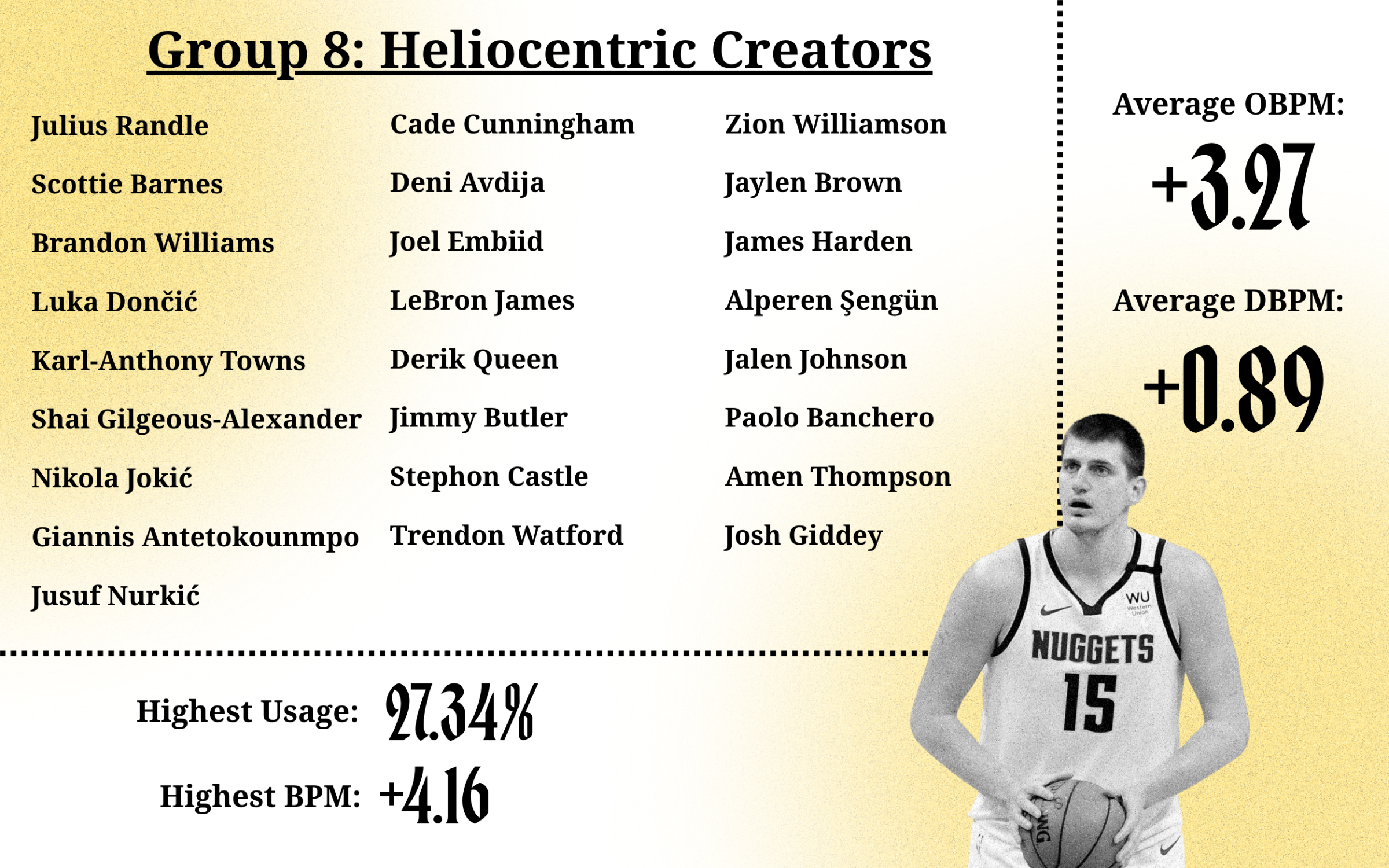
The final group is the headlining group of this experiment, with players like LeBron James, Nikola Jokic, and Shai Gilgeous-Alexander starring as the main offensive units for their teams. These players have the highest usage, assist rate (29.63%), and total BPM. These players are not separated by their height, as players like Stephon Castle and Derik Queen, although having different sizes, still end up with the ball in their hand at the end of the clock. Although not every player in this group is considered a superstar, almost everyone is a household name that creates huge impacts for their teams.
Summary:
An interesting result of this experiment is even though OBPM and DBPM were not used in the clustering algorithm, the outputted averages matched up with what a fan would predict these roles bring to an NBA offense and defense. There are also a lot of questions that could be brought up by players ending up in one group rather than another. Do players like Brandon Williams and Trendon Watford being in the group with all the heliocentric stars show a possibility for positive growth on the offensive side in the future? Maybe, but the start of the 2026 season does not show much growth from either player. Although the average BPM's show that some archetypes can be more valuable than others, every group does contain players who have positive OBPM and DBPMs, so judging players just by their role does not strictly mean that player is a net positive or negative.
I believe the best way to interpret these results is through trying to team build. The New York Knicks' team from last year had 8 main players, and only two of them were considered part of the same group on this exercise (Mikal Bridges and Landry Shamet both being 3&D players). The champion OKC Thunder team had 8 main players, and only three of them shared any group (Caruso, Wallace, and Wiggins all being defensive specialist guards). The teams that can get all the way to the NBA finals often have players with diverse skills that allow them to challenge teams in new ways every series. These groups also allow fans and teams to consider what a specific team might be good at. Having three 3&D guards in your rotation could leave your team weak to players would focus on the paint such as our group 0. At the end of the day, the goal was to find a better description for how the modern NBA distributes its roles, and the 8 archetypes show that playstyles rely more on threes than the older NBA terms allow for.
group averages:
My Code:
# Clusterting Algorithm for NBA Players - Nick Van Wagner

# Using Python, pandas
# Tables come from Basketball Reference, https://www.basketball-reference.com/leagues/NBA_2026_per_poss.html
# and https://www.basketball-reference.com/leagues/NBA_2026_advanced.html

import pandas as pd
import matplotlib.pyplot as plt
from sklearn.cluster import KMeans
from sklearn.preprocessing import StandardScaler

def InertiaTest(df_scaled):
    ks = range(1, 13)
    inertias = []
    for k in ks:
        km = KMeans(n_clusters=k, n_init=20, random_state=0).fit(df_scaled)
        inertias.append(km.inertia_)
        print(k, round(km.inertia_, 1))

    plt.plot(ks, inertias, marker="o")
    plt.xlabel("Number of clusters (k)")
    plt.ylabel("Inertia")
    plt.title("Intertia Scores vs Clusters")
    plt.show()


url_poss = "https://www.basketball-reference.com/leagues/NBA_2026_per_poss.html"
url_adv = "https://www.basketball-reference.com/leagues/NBA_2026_advanced.html"

# the first table on each page are the ones we will be using

table_poss = pd.read_html(url_poss)
table_adv = pd.read_html(url_adv)

df_poss = table_poss[0]
df_adv = table_adv[0]

# Basketball Reference has multiple rows for the same player when they are on
# multiple teams in one season, as well as their averages across those teams,
# so we simply remove the options that are not the '2TM/3TM' options.

df_poss = df_poss.drop_duplicates(subset="Player", keep="first")
df_adv = df_adv.drop_duplicates(subset="Player", keep="first")

# Drop copy columns, merge

df_adv = df_adv.drop(columns=["Rk", "Age", "Team", "Pos", "G", "GS", "MP", "Awards"])

df = pd.merge(df_poss, df_adv, on="Player", how="inner")

df = df.set_index("Player")

df = df[df["MP"] >= 820]

pct_cols = ["3P%", "2P%", "FT%"]
df[pct_cols] = df[pct_cols].fillna(0)

#print(df.columns)


df_num = df.select_dtypes(include="number")
df_num = df_num[["3P%", "2P%", "FT%", "3PAr", "FTr", "ORB%", "DRB%", "AST%", "STL%", "BLK%", "TOV%", "USG%"]]

df_scaled = StandardScaler().fit_transform(df_num)

InertiaTest(df_scaled)


labels = KMeans(n_clusters=8, n_init=20, random_state=0).fit_predict(df_scaled)
result = pd.Series(labels, index=df_num.index, name="cluster")

df["cluster"] = labels
feature_cols = ["3P%", "2P%", "FT%", "3PAr", "FTr", "ORB%", "DRB%",
                "AST%", "STL%", "BLK%", "TOV%", "USG%"]

summary = df.groupby("cluster")[feature_cols + ["OBPM", "DBPM"]].mean().round(2)
summary.insert(0, "Players", df["cluster"].value_counts().sort_index())

print(summary)

summary.to_csv("cluster_summary.csv")
df[["cluster"] + feature_cols + ["OBPM", "DBPM"]].sort_values("cluster").to_csv("players_by_cluster.csv")
Sources:
[1] Sports Reference. (n.d.). 2025-26 NBA player stats: Advanced. Basketball-Reference.com. Retrieved November 16, 2026, from https://www.basketball-reference.com/leagues/NBA_2026_advanced.html
[2] Sports Reference. (n.d.). 2025-26 NBA player stats: Per 100 possessions. Basketball-Reference.com. Retrieved November 16, 2026, from https://www.basketball-reference.com/leagues/NBA_2026_per_poss.html
Image Credits:
Austin Reaves photo: Lakers Austin Reaves by Erik Drost, licensed under CC BY 2.0. Cropped and edited. Cropped and edited.
Bam Adebayo photo: Bam Adebayo by Joe Glorioso, modified by Shakeydeal33, licensed under CC BY-SA 2.0. Cropped and edited.
Rudy Gobert photo: Rudy Gobert by Erik Drost, licensed under CC BY 2.0. Cropped and edited.
Giannis Antetokounmpo photo: Giannis Antetokounmpo by Erik Drost, licensed under CC BY 2.0. Cropped and edited.
Nikola Jokić photo: Nikola Jokic free throw by All-Pro Reels, licensed under CC BY-SA 2.0. Cropped and edited.
Tyrese Maxey photo: tyrese maxey 2026 76ers by Chensiyuan, licensed under CC BY-SA 4.0. Cropped and edited.
Victor Wembanyama photo: Victor Wembanyama San Antonio Spurs 2025 NBA Cup by Daiei Onoguchi, licensed under CC BY 4.0. Cropped and edited.
LaMelo Ball photo: LaMelo Ball by Erik Drost, licensed under CC BY 2.0. Cropped and edited.
Ausar Thompson photo: Ausar Thompson free throw by Pikraken, licensed under CC BY 4.0. Cropped and edited.
Payton Pritchard (Celtics at Wizards) photo: Boston Celtics 112–98 Washington Wizards in Washington, D.C. by Hameltion, licensed under CC BY-SA 4.0. Cropped and edited.